The tragedy of birds and bats

This institute has been studying bird migration routes using radar for 40 years. “A special feature of the Birdscan device is its complete automation: when the density of a flock of birds exceeds a certain threshold, the wind turbine stops functioning, its blades stop,” he told swissinfo. ch ornithologist Felix Liechti.

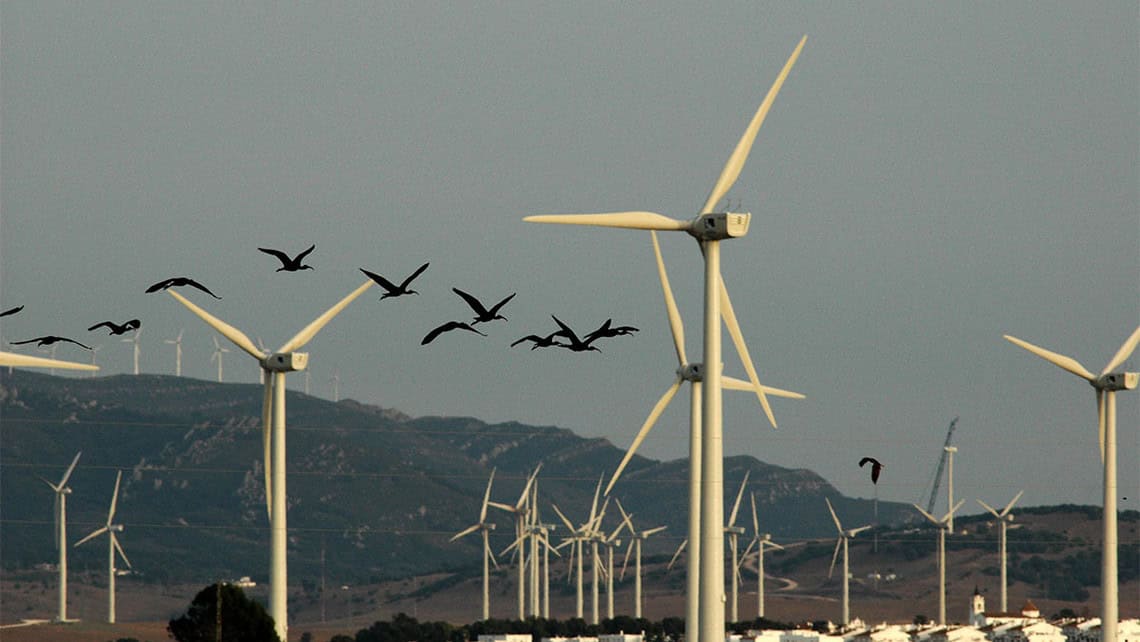
“The negative impact of wind turbines on the life and migration of birds has been known for a long time and confirmed by numerous studies,” recalls Felix Lichti. “The construction of a wind turbine entails serious changes in the parameters of the habitat, and some species of birds and other animals directly feel all the negative consequences of these processes. The greatest danger, however, is the blades of wind turbines. They are a huge risk factor for both local birds that nest in the region and for migratory ones. “

Indeed, for example, according to the Spanish National Society of Ornithology (SEO / BirdLife), wind generators in this country kill 6 to 18 million birds and bats annually. In North America, tens of thousands of birds die in the blades of wind turbines, including the bald eagles (Haliaeetus leucocephalus), the symbol of the United States.
How do windmills and birds get along?

These are very alarming numbers, but everything in the world is relative! This is what the proponents of extracting energy from wind power say. They indicate that the main cause of bird death is not the blades of the wind turbine. The vast majority of them die, crashing into the windows of buildings, becoming victims of cats, all kinds of chemicals and traffic. Isabelle Chevalley, Member of Parliament of the Confederation and President of the Association for the Promotion of Wind Energy in Switzerland (Suisse Éole), writes about this, in particular, in her book “The Wind Generator: Between Myth and Reality”.

“The nature of the impact of VEU on bird populations is not fully known to us,” admits Felix Lichti. “Each species is a special case and there are no statistics for them in Switzerland. Nevertheless, it would be a mistake to believe that, they say, a few dead birds “don’t make the weather,” ”he warns. For example, for such a species of birds as the “bearded man” (Gypaetus barbatus), Lichti explains, just two dead birds a year are enough for the state of the population to turn from stable to critical.

Recently, the Swiss Federal Office for the Environment (Bundesamt für Umwelt – BAFU) launched a process of interagency coordination and public expertise on its set of regulations governing the construction of wind turbine parks. “The idea is to provide a practical guide to better assess the impact of wind turbines on wildlife, birds and bats, and thus be able to recognize potential conflicts in advance,” explains Reinhard Schnidrig, head of the section “ Hunting, Fishing and Forest Biodiversity “at BAFU.

New technologies will protect migratory birds

Every year millions of birds migrate around the planet. For many of them, the journey is forever interrupted at the blades of wind turbines. The Swiss company has developed a radar to help solve this problem.

“This device is capable of recognizing a swarm of mosquitoes at a distance of five kilometers.” Urs Seiffert, head of the Swiss Birdradar project, has no doubts about the potential of this device. True, he is not interested in insects, but in migratory birds that cross the sky over Switzerland twice a year. “We are talking about tens of millions of birds moving in huge flocks or schools. The goal of the project is to avoid future bird collisions with wind turbines. ”

The Birdscan radar monitors a portion of the sky above wind generators (they are also called “wind turbines” or abbreviated “wind turbines”), says W. Seifert. “He is able to distinguish many types of birds. But that’s not what we want. We are more interested in the ability to measure the density of a school of birds.” The Swiss Ornithological Institute from the historic town of Sempach is also involved in this project.